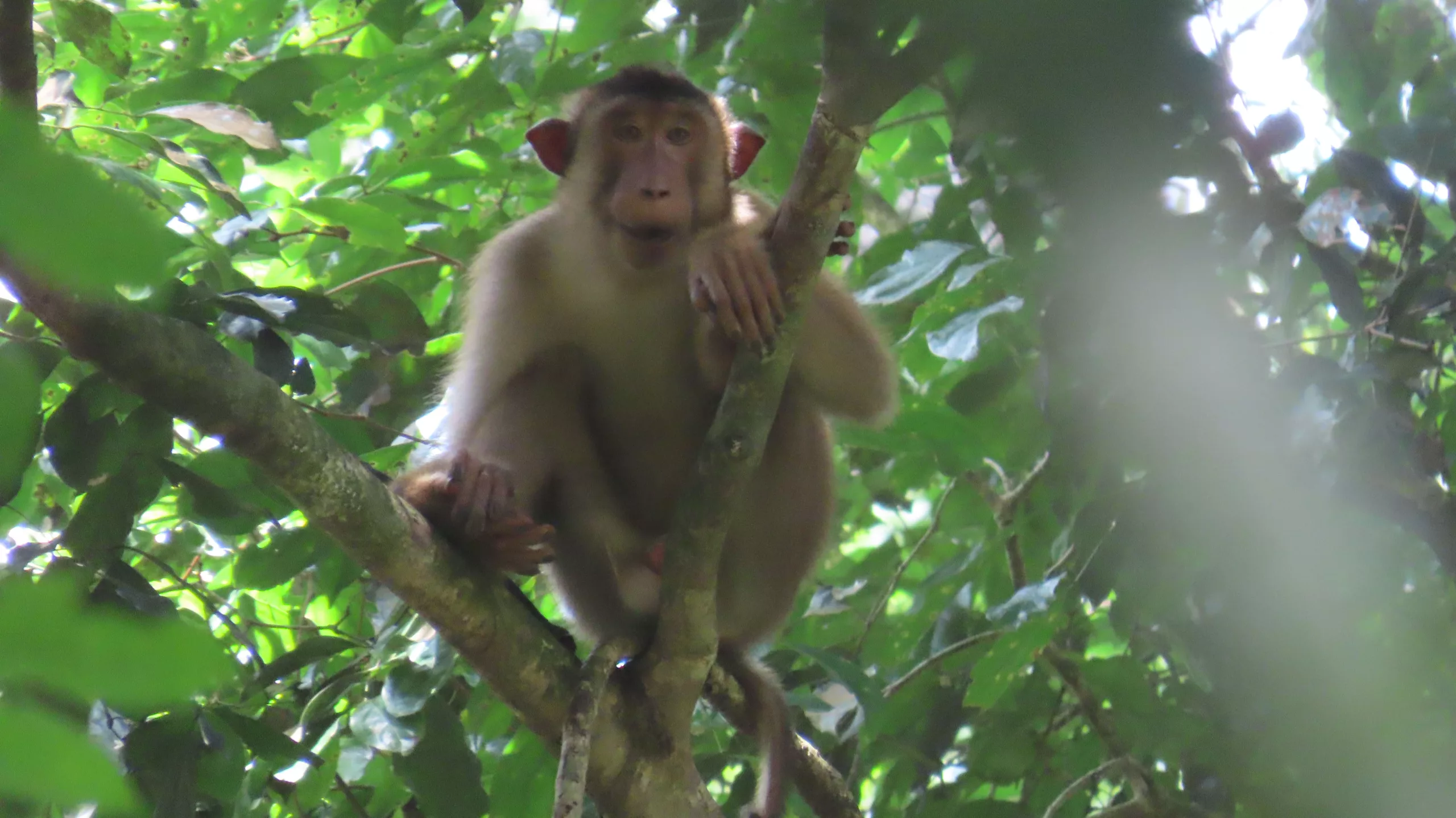
The pig-tailed macaque (Macaca nemestrina) is a primate from the Cercopithecidae family found across Southeast Asia, including Indonesia, Malaysia, southern Thailand and Brunei Darussalam. In some regions, it is also known as bodat.
Distinctive Features
The pig-tailed macaque has a robust body, measuring around 45–60 centimetres in females and more than 70 centimetres in males. Adults weigh approximately 5–15 kilograms. Its most distinctive feature is its short, curved tail resembling that of a pig, giving rise to its common English name, pig-tailed macaque.
Its coat ranges from olive brown to dark grey, with lighter-coloured underparts. Its strong limbs support a largely terrestrial lifestyle, with the species spending more time on the ground than several other Macaca species.
Active, Intelligent and Social
The pig-tailed macaque is diurnal, meaning it is active during the day. It lives in groups consisting of males and females, typically numbering around 15–40 individuals.
Within the group, macaques display a range of social behaviours, including grooming, vocal communication, play and dominance interactions. Their ability to recognise individuals, understand visual cues and adjust their foraging behaviour demonstrates a high level of social intelligence.
A Varied Diet, Strong Adaptability
The pig-tailed macaque is an omnivore, with fruit forming one of its main food sources. It also feeds on seeds, young leaves, flowers, fungi, insects, small crustaceans, bird eggs and small vertebrates.
Its ability to utilise a wide range of food sources helps it adapt when food availability changes. In modified habitats, pig-tailed macaques may also feed on cultivated plants such as oil palm, bananas and root crops. This can increase interactions between the species and human communities.
Vulnerable and in Need of Protection
The International Union for Conservation of Nature (IUCN) classifies the pig-tailed macaque as Vulnerable. This status indicates that the species faces a risk of extinction in the wild if threats to its habitat and population are not properly managed.
Protecting the pig-tailed macaque also means protecting the habitat and ecological processes that sustain the forest.
Dispersing Seeds, Sustaining Forests
As a fruit-eating species, the pig-tailed macaque plays a role in seed dispersal. Seeds carried through feeding and movement can be deposited in different areas, supporting the natural regeneration of vegetation. This role highlights how every species contributes to a functioning ecosystem. The pig-tailed macaque is not simply a forest inhabitant; it is part of the natural process that helps forests continue to grow and regenerate.